Drainage Excavation in Jersey City, NJ
Drainage excavation in Jersey City, NJ. French drains, swales, and perimeter drains dug to the right slope to carry water away from your home and yard.
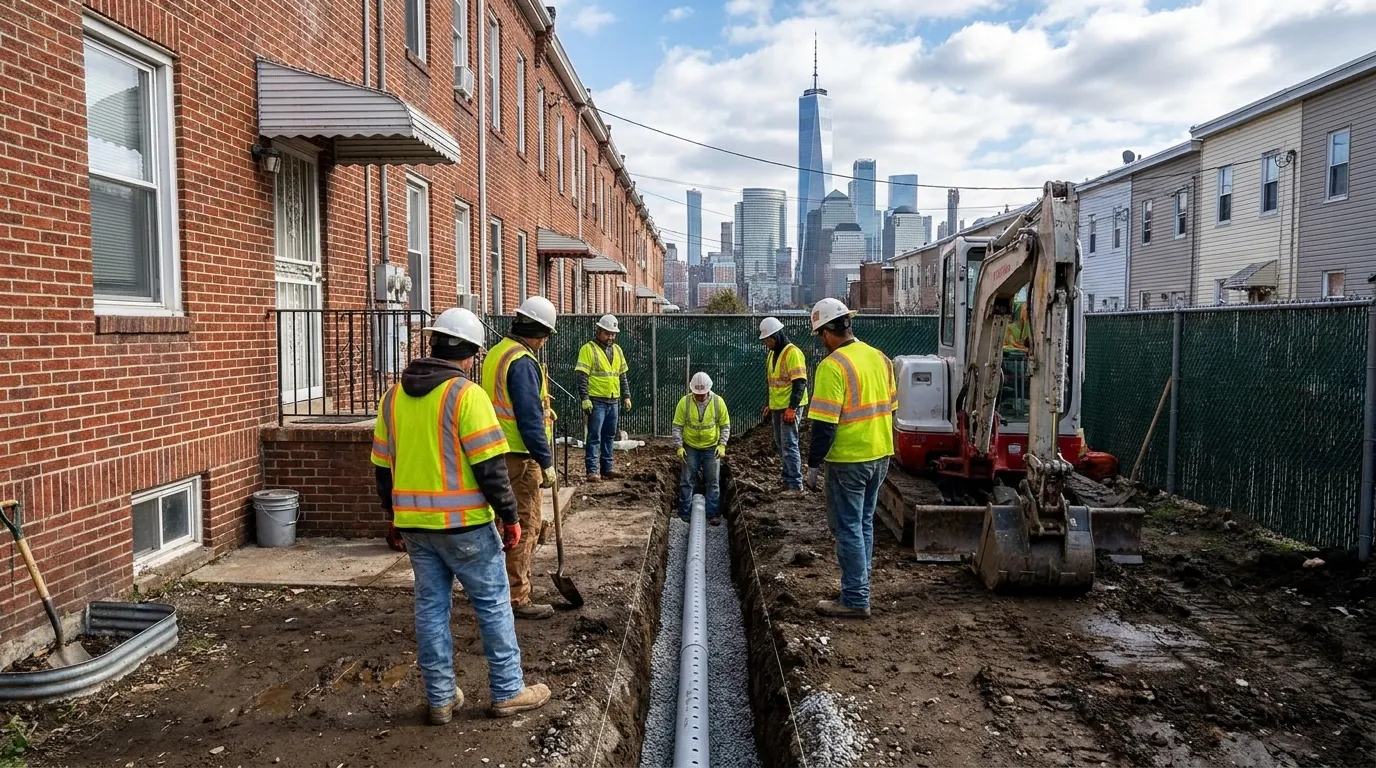
When water is the problem
Drainage excavation is the work of building a path for water to leave your property — a French drain, a swale, a perimeter drain around a foundation, a dry well, or a combination. The common goal is simple: move water by gravity from where it collects to a safe outlet, so it stops pooling against the house or standing in the yard.
The warning signs are familiar. Water sits in the yard for days after rain, the basement gets damp along one wall, a section of lawn stays spongy, or mulch and soil wash across a walk every storm. Each of those is water that has nowhere to go, and each is solved by giving it a graded path to an outlet.
Drainage work is closely tied to site grading, which handles surface water, and to trenching, which is the digging method for buried drain lines. On a foundation, it is planned with the foundation excavation so perimeter drainage goes in at the right stage.
How drainage work is planned
Good drainage starts with understanding where the water is going.
-
Trace the water
We look at where water collects, where it comes from, and where it can legally and practically be sent. Clay soil that holds water calls for a different plan than fast-draining sandy soil.
-
Design the path
We choose the system, whether a French drain, swale, perimeter drain, or a combination, and set the slope so water moves by gravity to the outlet.
-
Excavate and install
We trench to a steady fall, bed the pipe in the right stone, and wrap it to keep soil from clogging it, then build the outlet or dry well.
-
Backfill and restore
We backfill, compact where needed, and restore the surface so the finished yard drains without a sunken trench line running across it.
Why local soil decides the design
Drainage in this area is shaped by the ground. Clay-heavy soils hold water and drain slowly, so surface grading alone often is not enough — the water needs a piped path below ground to a real outlet. Sandy soils drain faster and may need a different, sometimes simpler, approach. Low-lying parcels near Jersey City sit close to the water table, which limits how deep a drain can go and where it can outlet. A plan that ignores which of these you have will underperform.
The region's humid summers deliver heavy, concentrated downpours that overwhelm undersized or poorly sloped systems, and freeze-thaw winters push water through the soil and can heave a shallow, poorly bedded line. That is why slope and bedding are not details — a drain with too little fall or the wrong stone around it silts up and stops working. Setting a steady grade to the outlet is the heart of the job.
Done right, drainage excavation is invisible after the surface is restored, and the difference shows only in a yard that dries out and a foundation that stays dry. That is the outcome the whole system is built around.
Fighting standing water or a damp basement?
Describe where the water shows up and when, and we will look at how it can be carried away.
Serving Jersey City and the surrounding towns.
Frequently asked questions
What is a French drain and when do I need one?
A French drain is a graded trench with a perforated pipe bedded in stone that collects water and carries it to an outlet. It is a common answer when water pools in the yard or seeps against a foundation, especially in slow-draining clay soil.
Does drainage excavation help a wet basement?
Often yes. A perimeter drain and proper backfill carry water away from the foundation walls before it can seep in, and this is usually paired with surface grading so runoff is directed away as well.
Why does slope matter in a drain?
Drainage works by gravity, so the line needs a steady fall to its outlet. Too little slope and water sits in the pipe and silts up, which is why setting and holding the grade is the core of the work.
Will my yard be torn up permanently?
No. The trench is backfilled, compacted where needed, and the surface restored, so a properly installed drain is invisible afterward and the only visible change is a yard that finally dries out.